Hyperscalers ARM vs AMD Compute Instances
By mid-2026, every major hyperscaler runs a production ARM line. AWS Graviton5 (Neoverse-V3) powers M9g instances. Azure Cobalt 100 (Neoverse-N2) ships in Dpsv6, with a Cobalt 200 preview (Neoverse-V3) promising up to 50% better CPU. Google Cloud Axion splits across N4A (Neoverse-N3, mainstream) and C4A (Neoverse-V2, heavy). Oracle OCI Ampere A4 (Ampere-1a) targets the low-cost segment. The Arm cloud is no longer an experiment: it is an infrastructure tier.
CPU Performance: Four ARM Plans, Measured
I ran four Hyperscaler ARM trials in the past month, all at 8 vCPU / 32 GB with an OS disk between 256 and 320GB, all in the US. The results are published in a dedicated Hyperscaler ARM Best VPS ranking. Each grade is a number between 0.0 and 6.0. The CPU grades from those trials tell a clear story:
| Provider | Plan | CPU grade | CPU arch detected | Price/mo |
|---|---|---|---|---|
| AWS | m9g.2xlarge |
5.32 | Neoverse-V3 | $285.59 |
| Google Cloud | n4a-standard-8 |
5.12 | Neoverse-N3 | $224.84 |
| Azure | D8ps_v6 |
4.96 | Neoverse-N2 | $202.32 |
| Oracle OCI | A4 8 vCPUs 32GB |
3.63 | Ampere-1a | $105.35 |
Trial links: AWS m9g.2xlarge, Azure D8ps_v6, GCP n4a-standard-8, OCI A4.
AWS leads on raw CPU with Graviton5's Neoverse-V3 cores and it earns A grades across CPU, web and stability, the only plan in the cohort to do so. Google's Axion N4A is close behind with excellent CPU numbers (5.12), though its overall score was dragged down by disk and network subsystems unrelated to compute. Azure's Cobalt 100 is balanced and stable, and it is the most affordable option among the top three at $202/mo. OCI's Ampere A4 is the cheapest by far, but its CPU score trails the cohort by a wide margin: you get what you pay for.
The AMD Baseline
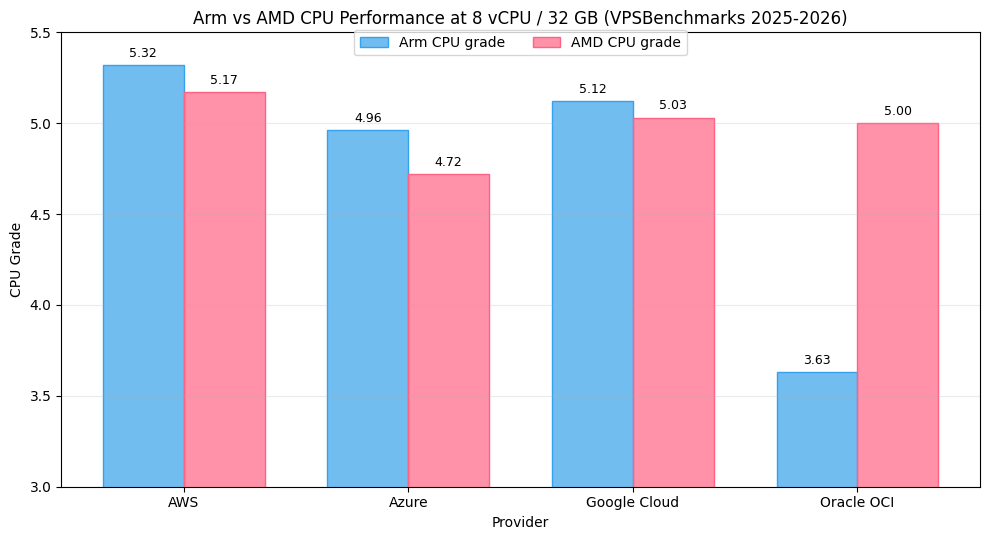
To answer the value question, we need x86 siblings. we have comparable AMD-based trials at the same 8 vCPU / 32 GB sizing across the same providers:
| Provider | Plan | CPU grade | CPU | Price/mo |
|---|---|---|---|---|
| Google Cloud | c4d-standard-8 |
5.03 | AMD EPYC Turin (5th Gen) | $273.01 |
| Oracle OCI | E6 8 vCPUs 32GB |
5.00 | AMD EPYC (5th Gen) | $134.32 |
| Azure | D8as_v6 |
4.72 | AMD EPYC 9004 (4th Gen) | $261.36 |
| AWS | m7a.2xlarge |
5.17 | AMD EPYC Genoa (4th Gen) | $333.85 |
Trial links: AWS m7a.2xlarge, Azure D8as_v6, GCP c4d-standard-8, OCI E6.
The AMD data is striking. Oracle's E6 delivers a 5.00 CPU grade at $134/mo, essentially half the price of the nearest competitor for comparable CPU performance; it was also ranked #1 in the 2025 Hyperscaler 8-Core category. Google's c4d-standard-8 on AMD Turin scores 5.03 CPU at $273, competitive with Graviton5. AWS's m7a.2xlarge (Genoa) ties or beats Graviton5 on raw CPU at 5.17, though at a $48/mo premium over the ARM plan. Azure's D8as_v6 is the most recent AMD v6-series addition to the Azure lineup.
Are ARM Instances Better Value Than AMD?
The short answer: not as a blanket statement; it depends entirely on provider and generation. Here is the per-provider verdict:
AWS. Graviton5 (5.32 CPU, $286) vs AMD Genoa (5.17 CPU, $334). The ARM plan is cheaper and faster. This is a clear ARM win on value: about 15% better price-performance on CPU.
Azure. Cobalt 100 (4.96 CPU, $202) vs AMD EPYC 9004 (4.72 CPU, $261). Again, ARM is cheaper and stronger on CPU. Azure's Cobalt story is the most balanced value proposition in the cohort: the best price-performance ratio among the top three ARM plans.
Google Cloud. Axion N4A (5.12 CPU, $225) vs AMD Turin c4d (5.03 CPU, $273). The ARM plan is slightly ahead on CPU and $48/mo cheaper. But note: Google's C4A (Neoverse-V2, targeting heavier workloads) would be the fairer comparison against Turin, but that trial has not yet been published. The N4A win is real but incomplete.
Oracle OCI. Ampere A4 (3.63 CPU, $105) vs AMD E6 (5.00 CPU, $134). This is the clearest counterexample. For $29/mo more, the AMD E6 delivers 38% more CPU capacity. On OCI, AMD is unambiguously better value than ARM: the ARM plan is cheap but underpowered.
Verdict
In 2026, ARM is a strong value contender at three of four hyperscalers. AWS Graviton5 and Azure Cobalt 100 both beat their AMD siblings on CPU performance and price. Google's N4A does too, though the C4A vs Turin comparison is still pending. The outlier is OCI, where AMD EPYC handily outperforms Ampere at a modest price premium.
The headline is not "ARM beats AMD"; it is that the CPU architecture matters less than the specific instance generation and how aggressively the provider prices it. Buyers should benchmark the actual plan, not the ISA. In 2026, the best value at AWS and Azure is ARM; at OCI, it is still AMD.
Recent Provider News
- Contabo Launches a New VPS Portfolio: Core, Performance, and Max Performance
- ScalaHosting Partners with MariaDB Foundation and Moves Its Fleet to MariaDB 11.8
- VPSLab Introduces 10 Gbps Premium Network Upgrade for Linux VPS, Windows RDP, and Storage VPS
All Provider News
See also VPS Coupons